Download Ebook Competing Against Luck: The Story of Innovation and Customer Choice, by Clayton M. Christensen Karen Dillon
Have you provided what should you get today? Exists any plan and concept to get the new collection of publication? Well, if you have not that type of plan, we will certainly influence you and make sure you to take it in noted. Book is much advised to be constantly in listing for you. It is sort of everyday necessity. So, when you set aside much cash for other necessities, you likewise need to allot some money to get the book.
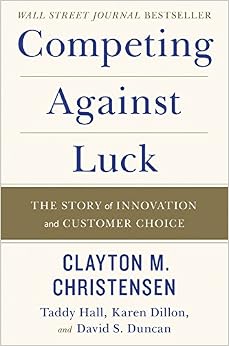
Competing Against Luck: The Story of Innovation and Customer Choice, by Clayton M. Christensen Karen Dillon

Download Ebook Competing Against Luck: The Story of Innovation and Customer Choice, by Clayton M. Christensen Karen Dillon
Now available! Competing Against Luck: The Story Of Innovation And Customer Choice, By Clayton M. Christensen Karen Dillon as one of the most needed book in the world. The book that is for grownups and teenagers are coming. You could have been waiting for this publication for long moments. So, this is the correct time to obtain it. Never ever play with the time anymore, when you have the opportunity to gain this publication, why should have fun with it? When looking the title of this publication here, you will straight visit this web page. It will certainly position you to make far better selection of reviewing book.
Feeling tough to obtain this best seller book? Why? We think that best seller book will always run out swiftly. So, it's not to odd when you will feel challenging to get it in the book shop, or you should bespeak Competing Against Luck: The Story Of Innovation And Customer Choice, By Clayton M. Christensen Karen Dillon when you need it. Have adequate time? Not everyone can await log minute to obtain guide. To overcome this problem, we are below to provide you remedy. It is not really difficult for us. We definitely assist you by offering the listings of the new best seller books in the world.
To understand exactly how guide will certainly be, it will be interacted with the efficiency as well as look of the book. The topic of the book that you intend to review need to be connected to the subject that you need or the topic that you like. Checking out normal publication will not be interested for you also you have actually held in on your hands. This is one issue to constantly fix. However right here, when getting Competing Against Luck: The Story Of Innovation And Customer Choice, By Clayton M. Christensen Karen Dillon as recommendation, you might not fret anymore.
Lots of people may have various need to read some publications. For this book is additionally being that so. You could locate that your factors are various with others. Some could read this book for their deadline responsibilities. Some will certainly read it to enhance the knowledge. So, what sort of factor of you to read this impressive Competing Against Luck: The Story Of Innovation And Customer Choice, By Clayton M. Christensen Karen Dillon It will rely on just how you stare as well as think about it. Simply get this book now as well as be among the incredible readers of this publication.
Product details
Hardcover: 288 pages
Publisher: HarperBusiness; 1 edition (October 4, 2016)
Language: English
ISBN-10: 0062435612
ISBN-13: 978-0062435613
Product Dimensions:
6.3 x 1 x 9.2 inches
Shipping Weight: 1 pounds (View shipping rates and policies)
Average Customer Review:
4.5 out of 5 stars
163 customer reviews
Amazon Best Sellers Rank:
#10,219 in Books (See Top 100 in Books)
The crux of success in innovation is adoption. We may think we know what our customers will like, but more often than not, we are surprised and dismayed when we watch our “innovative†product or service flounder after launch.The odds of creating exactly the right product or service to disrupt a vulnerable incumbent are probably less than 25%. Failure is expensive as it comes late in the development cycle after the investment of time, energy and money.Best-selling author and Harvard professor Clayton Christensen provides answers and a solution in “Competing Against Luck†which comes after two decades of research where he carefully and inductively observed people who bought and sold things. What is the customer trying to do with the purchase? Why does the seller think the customer needs the product?He found a big disconnect… and the answer to why adoption is often not achieved. He also found a solution. He urges readers to abandon the old way of framing customer’s needs and look at the customer through a new lens with one question, “What is the customer hiring the product to do? What is the job?â€â€œThe fundamental problem is that companies accumulate masses of data that are not organized in a way that enables them to reliably predict which ideas will succeed. But none of the data tells you why customers make the choices they do."Now with “Competing Against Luck,†Christensen offers a paradigm change, “The Jobs Theory,†that provides a new lens and a discovery mindset that will help innovators (and investors) answer one of the most important questions that has bedeviled us for decades: is innovation inherently a question of luck? With this new tool, the answer is no.In Section 1, “An Introduction to Jobs Theory,†he defines “what is a job?†and goes on to put meat on the bone by explaining what is not a job, how can we discern a job and what are the theory’s limits.â€To understand a job, it is critical to understand what “progress†is for the customer. A job is defined “as the progress that a person is trying to make in a particular circumstance.†It’s key to why choices are made. It represents movement.Circumstance is fundamental to finding a solution. Where are you? Who are you with? While doing what? What were you doing ½ an hour ago? What are you doing next? What social or cultural or political pressures are exerting influence?Social and emotional needs can far outweigh any functional desires. Who will I trust to take care of my children? The old ways of organizing - centered on product attributes, customer characteristics (lifestage, financial status, etc.), trends and competitive response - are insufficient.In contrast to what is normally baked into today’s customer research, neither product/service cost nor efficiency are a core element to defining a job. Also, Christensen notes from his research that new products succeed not because of the features and functionality they offer but because of the experiences they enable. When you enable the right experience for your customer, they will pay a premium price.Section 2 gets at the nuts and bolts of how to apply the theory. The author challenges us to uncover jobs to be done in our own life. Look for opportunities in non-consumption, identifying workarounds, zoning in on things we do not want to do and spotting unusual uses of products.While it is important to listen to the customer, you have to listen to hear what your customers don’t say. “Rarely can the customer articulate the requirements accurately or completely – their motivations more complex in their pathways to purchase more elaborate than they can describe. What they hire – and equally important, what they fire – tells a story.†Steve Jobs was famously known for listening to what was not said.Southern New Hampshire University, which has become a national leader in online education, sought answers to these questions when trying to ascertain “what they were being hired to doâ€: What are the experiences customers seek in order to make progress? What obstacles must be removed? What are the social, emotional and functional dimensions?In Section 3, Christensen outlines how one can create a Jobs focused organization. There are many critical elements. One is metrics. What gets measured gets done. Creating the right metrics is hard but important. Companies get focused on revenue instead of delivering the customer benefit. We can consider metrics like “how much time do we save this customer? Do we improve their cash flow?†He notes that Amazon focuses on when orders are delivered not when they are shipped.He goes on to note the problems of the old frame. Engineers and operators have focused on the product specification rather than the “job specification.†As a result, the organization has overweighted the value of its technology and underweighted the downstream applications of that technology to solve customer problems that enable their desired progress.There is a lot in “Competing Against Luck†to unpack. Just keep in mind that Christensen’s Jobs Theory was developed not to explain past successes but to help us increase the predictability of new ones. Identifying and understanding the job is only the beginning. Having empathy for the customer so we can create the right set of experiences in solving the job- is the key. It is easier for competitors to copy products but it is difficult for them to copy experiences that are well integrated into your offering.Should you buy this book?…that depends on the progress you seek and the job that needs to be done. By digging in and applying this new lens, you can cede luck to your competitors and leave them in the dust.Some afterthoughts:• NetFlix was hired to provide entertainment anywhere, anytime with control over time without a penalty.• Why didn’t Hertz come up with the Zipcar?• Why didn’t Kodak excel in digital photography?• Why is Sports Illustrated being fired for ESPN?• Why is Amazon buying Whole Foods?
In 1995 the term “disruptive innovation†was coined by Harvard Professor, Clayton Christensen to describe how certain types of innovation change industries. But this is rare. Most innovation doesn’t amount to much, and fizzles out despite extensive quantitative research and Herculean advertising efforts.In this book, Christensen et al, offer a simple but profound insight which they call the ‘Theory of Jobs to Be Done.’ The purpose of this insight is to shed light on why people adopt an innovation in large enough numbers to make it a success, and how to identify innovations that will be adopted.‘The job to be done’, they assert is the causal mechanism for successful innovation. Using this insight enables companies not only to create but also to predict new innovations that will succeed. Phrasing the innovation in this manner allows for a deep understanding of the customers’ need at a more profound level.To introduce this concept, the authors describe (among other examples,) the “job of a milkshake.†Why would someone “hire†a milkshake? What “job†is the milkshake expected to perform? “We all have jobs we need to do that arise in our day-to-day lives and when we do, we hire products or services to get these jobs done,†the authors explain.If you can answer this question, increasing sales is far more likely to be useful than doing taste tests, demographic surveys and purchase studies.When looking for an answer to this question (an actual case), the researchers were surprised to find that an oddly high number of milkshakes were sold before 9:00 a.m. to people who came to the fast-food restaurant alone. Doing taste tests, demographic surveys and purchase studies would not yield the quality of information that came from asking this question: “Excuse me, please, but I have to sort out this puzzle. What job were you trying to do for yourself that caused you to come here and hire that milkshake?â€It turned out that they had long and boring rides to work and needed something to keep the commute interesting. Coffee doesn’t do the job well because it gets cold too quickly, eating bananas makes you feel too full, but hiring a milkshake does the job well. It is thick enough to sip, lasts long enough, and remains pleasurable through the journey.Approaching the study from the ‘job to be done’ perspective is quite different to fast-food restaurants asking a patron to give feedback in one of its customer surveys to the question: “How can we improve this milk shake so you buy more of them?†A single dad coming to a restaurant with his young son would answer the survey very differently to the same man when he buys a milkshake for his morning commute. The milkshake is hired for very different jobs, in two very different circumstances.So how can one identify innovative opportunities if compiling data-rich models only makes businesses “masters of description but failures at predictionâ€? “We believe Jobs Theory provides a powerful way of understanding the causal mechanism of customer behaviour, an understanding that, in turn, is the most fundamental driver of innovation success,†the authors explain.So how is Jobs Theory to be applied so that you create products that customers will not only want to buy, but will even be willing to pay premium prices for? Simply put, customers don’t buy products or services: they pull them into their lives to resolve highly important, unsatisfied jobs that arise.Jobs are never simply about the function of the service or product. The circumstance is central to their definition, not customer characteristics, product attributes, new technology, or trends. Just think of how you would hire a baby-sitter – who would you trust with your children?“It’s important to note that we don’t ‘create’ jobs, we discover them,†the authors explain. This is a 180 degree shift from viewing innovation as creating what no-one has ever seen before, and then trying to stimulate a need.Jobs can be discovered in many ways. One is just watching the customers you do—and don’t—already have, and looking for the job that they want done. Do many DIY customers in your hardware store need technical assistance?You can also learn much about a Job to Be Done from people who aren’t hiring any product or service to do the Job. Airbnb reports that 40% of their “guests†say they would not have made a trip at all, or would have stayed with family, if Airbnb didn’t exist. As such, Airbnb is not in competition with hotels. There may be an entirely new growth opportunity right in front of you.Are people creating ways of working around a problem or just compensating for it? Banking giant ING saw the segment no bank wants, low net-worth individuals, who want a simple, inexpensive banking facility. They were being chased away by high banking charges and other barriers. ING created ING Direct that has no deposit minimums, is fast, convenient, and secures your money. Of course, you won’t see workarounds if you’re not fully immersed in the context of the consumers’ struggle.There are probably more jobs people do not want to do than jobs they want to do. Negative jobs are often the best innovation opportunities. Because most people don’t want to go to the doctor if they don’t have to, there are now more than a thousand MinuteClinic locations inside CVS pharmacy stores in thirty-three states in America.Innovation can also be identified in the unusual use of products. NyQuil had been on the market for decades as a cold remedy, but some consumers were using it to help them sleep, even when they weren’t sick. This led to ZzzQuil, which offers a good night’s sleep without the other active ingredients consumers didn’t need.Growth can be found where none seems possible. It is dependent on knowing what to look for, and the question to be asked: What is the Job here?There are gems in this easy-to-read book, with many examples of every point they make. No matter your line of work, this is a clever way to look for new business, but it must be done carefully and slowly.Readability Light -+--- SeriousInsights High +---- LowPractical High -+--- Low*Ian Mann of Gateways consults internationally on leadership and strategy and is the author of Strategy that Works.
Clay Christensen once again demonstrates why he is the preeminent authority on innovation. His Jobs Theory is applicable as a method to critically think about why consumers buy ("hire") products and services, and why they switch ("fire"). Jobs Theory forces the providers of products and services to get into the mind of the customer.
Competing Against Luck: The Story of Innovation and Customer Choice, by Clayton M. Christensen Karen Dillon PDF
Competing Against Luck: The Story of Innovation and Customer Choice, by Clayton M. Christensen Karen Dillon EPub
Competing Against Luck: The Story of Innovation and Customer Choice, by Clayton M. Christensen Karen Dillon Doc
Competing Against Luck: The Story of Innovation and Customer Choice, by Clayton M. Christensen Karen Dillon iBooks
Competing Against Luck: The Story of Innovation and Customer Choice, by Clayton M. Christensen Karen Dillon rtf
Competing Against Luck: The Story of Innovation and Customer Choice, by Clayton M. Christensen Karen Dillon Mobipocket
Competing Against Luck: The Story of Innovation and Customer Choice, by Clayton M. Christensen Karen Dillon Kindle